

Medically Reviewed by Dr. Sneha Patel on September 25, 2026
A broken tooth can stop you in your tracks, whether it happens during a meal, a fall, or out of nowhere. The good news is that yes, in many cases, a dental crown can fix a broken tooth, restoring both its function and appearance in a way that feels natural. Whether a crown is the right repair for your tooth, though, depends on where the break is, how deep it goes, and how much healthy structure is left. The sections below focus on that decision: what to do in the first few hours, how we sort a broken tooth into bonding, a filling, a crown, or an extraction, and why a break on a front tooth is often handled differently than one on a molar.
At Dentistry on Main Street, a locally owned practice serving New Port Richey, our team provides restorative dentistry solutions designed to protect damaged teeth and help you get back to feeling like yourself. Whether the break is minor or more significant, we’ll walk you through every option so you can make a confident, informed decision about your care.
2 visits
typical appointments needed to prepare and place a crown
5–15 yrs
how long a well-maintained crown can last, per Cleveland Clinic
1 cap
covers the entire visible tooth to reinforce and protect it
What to Do Right After a Tooth Breaks
What you do in the first few hours can affect how well the tooth responds to treatment. Rinse your mouth gently with warm water, and apply a cold compress to the outside of your cheek to reduce swelling if the injury involved trauma. Save any broken piece if you can, avoid chewing on that side, and call our office rather than waiting to see if the discomfort passes on its own. A tooth that seems fine at first can still have hidden cracks that worsen without treatment.
If the break came with severe pain, bleeding that will not stop, or swelling in your face or gums, treat it as urgent. Our emergency dental care team offers same-day appointments, and our post on signs you need emergency dental care explains which symptoms should not wait.
What Makes a Tooth a Good Candidate for a Crown
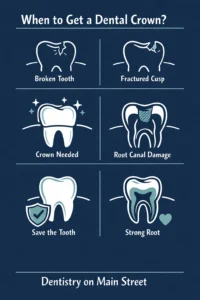
Not every broken tooth automatically needs a crown, but crowns are one of the most versatile solutions available. A crown is a tooth-shaped cap that fits over the entire visible portion of a tooth, reinforcing its structure and preventing further damage. When a tooth is cracked, fractured, or broken in a way that leaves enough of the root and base intact, a crown can restore it fully.
Crowns are typically recommended when a break is too large for a filling to repair reliably, when a cusp has fractured off, or when the tooth has been weakened after a root canal. Cleveland Clinic recommends a crown when a large piece of the tooth breaks away, since the cap protects a tooth that has been weakened or seriously damaged while also improving how it looks.
When a Crown May Not Be the Right Option
If the tooth is broken at or below the gum line, or if the root itself is severely damaged, extraction may be a more realistic path. In those situations, our team can discuss tooth extractions and replacement options such as a dental implant to restore the gap left behind. However, in the majority of cases involving a broken tooth that still has a healthy root, a crown is a highly effective solution.
Crown vs. Filling vs. Extraction: How We Decide
Not every broken tooth needs the same fix. The right treatment depends on how much of the tooth structure remains and whether the root and nerve are still healthy.
| Break Severity | Likely Treatment | Why |
|---|---|---|
| Small chip, minimal structure loss | Filling or bonding | Enough healthy tooth remains to bond directly |
| Cusp fracture or large break above the gumline | Dental crown | Root and base are intact, but the visible structure needs full coverage |
| Break at or below the gumline, damaged root | Extraction with replacement | Not enough healthy structure left to support a crown |
Front Tooth vs. Back Tooth Breaks: Why Location Changes the Fix
Where the break happens matters almost as much as how big it is. Front teeth handle lighter biting forces and sit in the most visible part of your smile, so a small chip on an incisor can often be repaired with tooth-colored bonding in a single visit. Our post on what dental bonding can fix covers when that conservative route makes sense.
Back teeth are a different story. Molars and premolars absorb most of the pressure of chewing, and when a break takes off a cusp or leaves a large filling unsupported, a small repair may not hold up. Full coverage from a crown helps hold the remaining tooth together and spreads chewing forces more evenly. Cracks in back teeth can also be harder to spot. According to the American Association of Endodontists, a cracked tooth often causes erratic pain when you chew, sometimes as you release your bite, along with sensitivity to hot or cold that comes and goes.
Front Teeth
Lighter bite forces and high visibility. Small chips often suit bonding, while larger breaks may need a tooth-colored crown.
Back Teeth
Heavy chewing forces. A lost cusp or a crack across the tooth usually calls for the full coverage of a crown.
What the Crown Process Looks Like
Many patients feel uncertain about getting a crown because they’re not sure what to expect. The process typically takes two appointments and is more straightforward than most people anticipate.
1. Exam and Shaping
The tooth is examined, damaged structure removed, and the tooth shaped to fit the crown.
2. Impression and Temporary
An impression is taken for the custom crown, and a temporary protects the tooth between visits.
3. Placement and Adjustment
The permanent crown is placed, color-matched, and adjusted for a comfortable bite.
During the first visit, the tooth is examined, any damaged structure is removed, and the tooth is shaped to accommodate the crown. An impression is taken so the restoration can be custom-made to fit your bite precisely. At the second appointment, the permanent crown is placed and adjusted for comfort. Our team takes care to match the crown’s color and shape to the surrounding teeth, so the result blends in naturally with your smile.
If you have already been told a crown is the right fix and want a closer look at crown materials, the two-visit process, and aftercare, our companion article on how a crown repairs a broken tooth, from material choice to aftercare goes deeper on each step.
How Crowns Hold Up Over Time
Dental crowns and bridges are designed to withstand the daily demands of chewing, speaking, and biting. Cleveland Clinic puts the average lifespan of a dental crown at five to 15 years, and routine dental visits and consistent at-home care help you get the most out of that range. Avoiding habits like chewing ice or grinding teeth helps extend their lifespan significantly.
Other Restorative Options That Work Alongside Crowns
Sometimes a broken tooth has additional needs beyond the crown itself. If the break has affected the inner pulp of the tooth, root canal treatment may be needed first to remove infection and stabilize the tooth before a crown is placed. This combination approach allows us to save a tooth that might otherwise require extraction.
If the root is too damaged to save, our team can walk you through replacement options; our post on whether dental implants are safe covers candidacy and the step-by-step process in more detail. For patients curious about all the considerations that come with getting a crown, our blog on the pros and cons of dental crowns is a helpful resource that covers common questions in detail. Understanding your full range of options makes it much easier to feel confident moving forward with treatment.
Get Your Broken Tooth Evaluated at Dentistry on Main Street
If you’re dealing with a broken tooth, the sooner you have it looked at, the better your options tend to be. Prompt treatment can mean the difference between saving the tooth and needing a more involved restoration down the road. Our dental crowns are crafted to restore your tooth’s strength and appearance so you can eat, smile, and speak without hesitation.
At Dentistry on Main Street, Dr. Sneha Patel and Dr. Michael Snyder are committed to making your dental care as comfortable and straightforward as possible. Our office proudly serves the New Port Richey community and the surrounding areas, including Trinity, Odessa, and Seven Springs, with personalized, patient-centered treatment in a welcoming environment. When you’re ready to take the next step, contact our office to schedule your evaluation and find out how we can help restore your smile.
Frequently Asked Questions About Dental Crowns for Broken Teeth
Is a broken tooth always a dental emergency?
Not always, but it should still be evaluated promptly. A small chip with no pain can often wait for a regular appointment, while a break with pain, sharp edges, or visible nerve exposure needs to be seen right away.
Can I wait to fix a broken tooth if it doesn’t hurt?
Waiting is risky even without pain. A break can allow bacteria to reach the inner tooth, and sharp edges can cut the tongue or cheek. Getting it evaluated quickly usually means simpler, less costly treatment.
Do I need a root canal before getting a crown?
Only if the break has reached the inner pulp of the tooth. If the nerve is healthy, a crown alone can restore the tooth. If infection or nerve damage is present, root canal treatment is typically completed first.
What materials are dental crowns made from?
Crowns can be made from porcelain, zirconia, metal alloys, or a combination of materials. Your dentist will recommend a material based on the tooth’s location, bite forces, and your cosmetic goals.
Will my broken tooth feel normal again after a crown?
Most patients adjust to a new crown within a few days and can chew, speak, and smile normally. Minor sensitivity to temperature is common at first and typically fades as the tooth and gum tissue settle.
Can a broken front tooth be fixed without a crown?
Often, yes. Small chips on front teeth can usually be repaired with tooth-colored bonding, which is shaped directly on the tooth in one visit. A crown becomes the better choice when a large portion of the tooth is missing, the break reaches the nerve, or the tooth has already been weakened by a large filling or root canal treatment.